


Understanding Your Rights After a Serious Lifting Injury on the Job
Key Takeaways: Yes, a herniated disc caused by lifting at work is generally covered by California’s no-fault workers’ compensation system, meaning you do not have to prove employer fault to receive benefits. Improper lifting techniques, such as using your back instead of your legs or twisting while carrying heavy loads, are recognized causes of disc herniation. To protect your claim, report the injury immediately, request a DWC-1 form, notify your employer within 30 days, and file an application within one year. Eligible workers receive medical treatment (including surgery, therapy, and imaging), temporary and permanent disability benefits, and up to $10,000 in care while the claim is pending. The law prohibits employer retaliation, and a prior back condition does not automatically disqualify your claim. Because insurers often dispute whether a disc injury is work-related, strong medical documentation and prompt action are essential.
Yes, a herniated disc caused by lifting at work is generally covered by California workers’ compensation. If you strained your spine hoisting a heavy load in a warehouse, on a construction site, or while moving a patient, the resulting disc injury qualifies as a compensable work injury. Workers’ compensation is a no-fault system, and the employer must provide benefits regardless of fault. You do not have to prove your employer did anything wrong to receive medical care and wage replacement.
For workers in the Inland Empire facing a life-altering back injury, the team at Kampf, Schiavone & Associates understands how frightening a diagnosis of nerve damage or disc herniation can be. Call our office at (909) 885-1522 or reach out through our confidential contact page to discuss your options.
What a Herniated Disc Actually Is and Why Lifting Causes It
A herniated disc happens when the soft cushioning between your vertebrae pushes out and presses on nearby nerves. This condition occurs most often in the lower back. When asymptomatic, it requires no treatment. When it does cause symptoms, however, the pain, numbness, and weakness can keep you out of work for months and threaten your long-term earning capacity.
Improper lifting is one of the most recognized causes of this injury. According to Mayo Clinic’s overview of herniated disk causes, using your back muscles instead of your leg muscles to lift large, heavy objects can overload your spine and lead to a herniated disk. Twisting and turning while lifting may damage the disk joint. For workers in physically demanding jobs, these movements are repeated dozens of times daily.
💡 Pro Tip: Report your injury the moment you feel it, even if the pain seems manageable. Disc injuries often worsen over hours or days, and a documented same-day report strengthens the connection between your job and your condition.
Filing a Back Injury at Work Workers Comp San Bernardino Claim
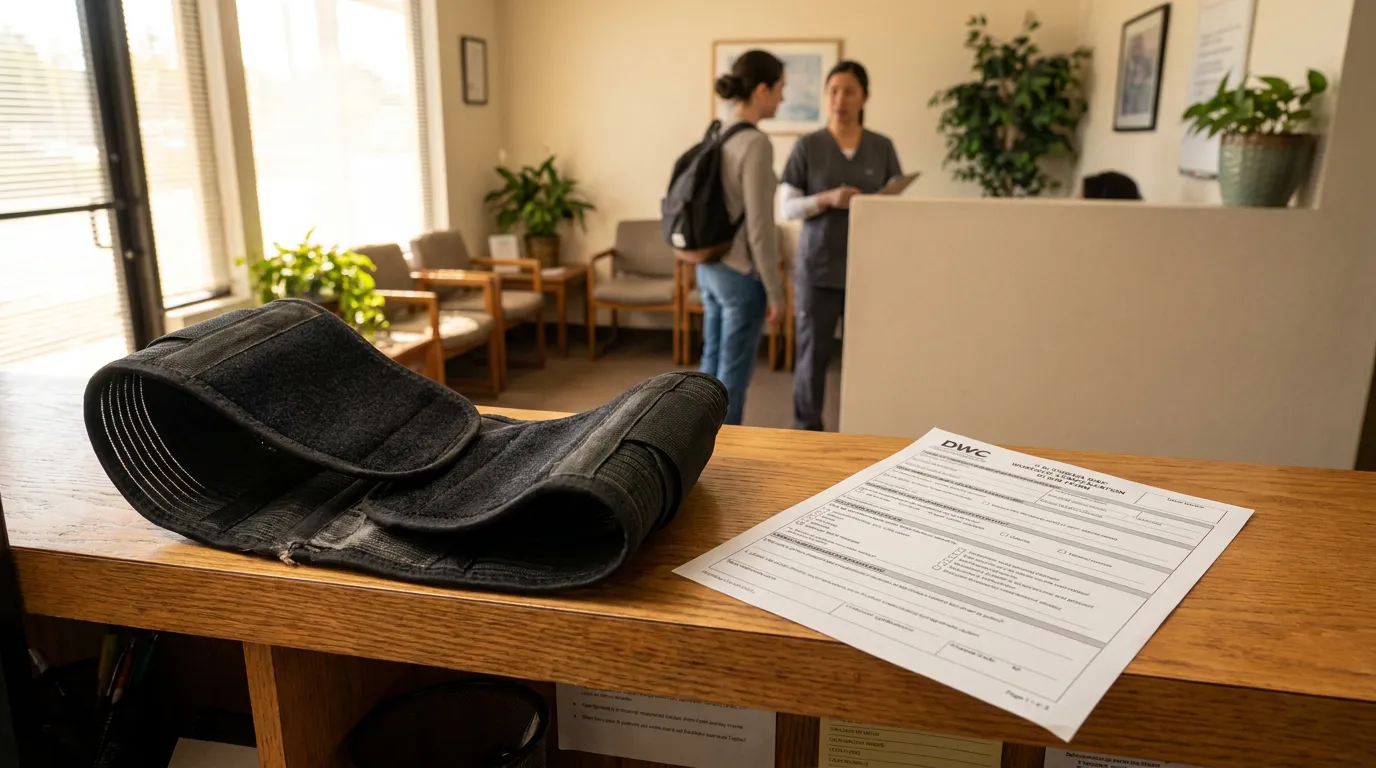
Starting your claim begins with formal notice and the right paperwork. If your employer does not provide a DWC-1 claim form, request one from management. This form is how you officially apply for benefits, and completing it promptly protects your right to medical care and wage replacement.
Deadlines are strict and courts tend to apply them narrowly. You must notify your employer of your injury within 30 days and file an application within one year of the injury. While limited exceptions may extend certain deadlines, you should never assume tolling applies automatically. Missing these windows can jeopardize an otherwise valid herniated disc lifting claim.
A successful back injury at work workers comp San Bernardino filing generally depends on:
- Prompt written notice to your employer within the statutory window
- A completed DWC-1 claim form submitted to the employer or insurer
- Medical documentation linking the disc herniation to work activity
- Credible witness statements or incident reports where available
- Consistent follow-up treatment records
💡 Pro Tip: Keep a personal file with copies of every form, medical record, and message you exchange with your employer or the insurer. Your own records can become powerful evidence if a dispute arises.
The Medical Benefits You Are Entitled to Receive
California law requires your employer to pay for the medical treatment your injury demands. Under California Labor Code § 4600(a), the employer must provide reasonably required medical care to cure or relieve the effects of a work injury. You can read the statutory framework in the state’s workers’ compensation medical treatment law. This coverage includes surgery, physical therapy, chiropractic care, hospital stays, medicines, and prosthetic or orthotic devices from the first day of injury.
While your claim is being reviewed, treatment does not have to stop. Once you file the DWC-1 claim form, the employer must authorize and pay for medical treatment up to $10,000 until the claim is accepted or rejected. This provision matters enormously for a herniated disc, where early imaging and conservative treatment can prevent a manageable condition from becoming permanent disability.
Treatment for a herniated disc ranges from conservative care to major surgery. Surgery typically is recommended only after other treatments have failed or when symptoms are severe. The procedure most frequently used is a diskectomy. Because surgical outcomes and recovery timelines vary widely, the value and complexity of a spinal injury workers comp California claim often grow over time.
| Benefit Type | What It Generally Covers |
|---|---|
| Medical treatment | Surgery, therapy, imaging, medication, devices |
| Temporary disability | Partial wage replacement while you recover |
| Permanent disability | Compensation for lasting impairment |
| Supplemental benefits | Support for qualifying prior serious impairments |
Protection From Retaliation and the Exclusive Remedy Rule
Your employer cannot punish you for exercising your legal rights. Your employer cannot discriminate or retaliate against you because of your job-related injury or for filing a workers’ compensation claim. If you experience demotion, termination, or harassment after reporting a lifting injury, that conduct may give rise to additional legal protections under California law.
Workers’ compensation is generally the exclusive remedy for a work injury. A covered employee normally cannot sue the employer in court. Instead, you receive defined benefits through the workers’ compensation system. Certain narrow exceptions can exist depending on the facts, which is one reason many injured workers consult a legal professional before accepting an insurer’s position.
💡 Pro Tip: If you have a pre-existing back condition, do not assume it disqualifies you. California’s system does not automatically deny benefits because of prior injuries, and in qualifying cases the Subsequent Injuries Benefits Trust Fund under California Labor Code § 4751 may supplement what you are owed when a serious prior disability combines with a new industrial injury.
Common Challenges Injured Workers Face
Insurers frequently dispute whether a herniated disc is truly work-related. Because disc degeneration can develop over years, an adjuster may argue your condition is age-related rather than caused by a lifting incident. Thorough medical documentation and a clear account of the workplace activity are often the difference between an approved and denied claim.
Coverage confusion is another recurring obstacle. Some employers carry combined insurance products, and California Insurance Code § 1749.02 defines "twenty-four hour coverage" as a joint workers’ compensation and health insurance product. When a herniated disc arises out of and in the course of employment, it belongs under workers’ compensation, not your personal health plan. Be cautious if anyone tries to redirect a compensable work injury to your private insurance.
Free guidance is available, and the state encourages workers to use it. Under California Labor Code § 139.6, the Division of Workers’ Compensation maintains an information and assistance program with officers who help resolve disputes without formal proceedings. For a clear explanation of how these deadlines and benefits apply to your situation, our overview of whether a San Bernardino worker can file a back injury claim breaks down the process in plain language.
💡 Pro Tip: Ask your treating physician to document exactly how the injury occurred and how it limits your work duties. Detailed causation notes carry significant weight if your lifting injury workers compensation claim is challenged.
Frequently Asked Questions
1. Does it matter if my own lifting technique caused the herniated disc?
Generally, no. California operates a no-fault system, so an injured employee does not need to prove the injury was someone else’s fault to receive benefits for an on-the-job injury. Poor lifting form does not bar coverage.
2. How long do I have to report and file my claim?
You face two separate deadlines. You must notify your employer within 30 days and file an application within one year of the injury. Certain exceptions may apply in limited circumstances, so acting quickly is the safest approach.
3. Who pays for my treatment while the claim is pending?
Your employer does, within statutory limits. Once you file the DWC-1 claim form, the employer must pay for medical treatment up to $10,000 until the claim is accepted or rejected.
4. Can I be fired for filing a herniated disc claim?
That conduct is prohibited. Your employer cannot discriminate or retaliate against you because of your job-related injury or for filing a workers’ compensation claim. Retaliation may create additional legal claims.
5. What if I had a prior back problem?
A previous condition does not automatically end your case. California’s framework can still provide benefits, and supplemental funds may apply where a serious prior impairment combines with a new serious injury.
Protecting Your Recovery and Your Future
A herniated disc from lifting is a legitimate, medically documented injury that California’s workers’ compensation system was built to address. Between guaranteed medical care, wage replacement, and protection from retaliation, the law offers meaningful support, but insurers do not always honor these rights without a fight. Outcomes depend on the specific facts of your case, your medical evidence, and how promptly you act. When your ability to earn a living is on the line, experienced guidance from a dedicated San Bernardino workers comp attorney can make a lasting difference.
If a serious back injury has upended your life, you do not have to navigate this alone. The advocates at Kampf, Schiavone & Associates are trusted by injured workers across the Inland Empire for handling high-impact, life-changing injury claims. Call (909) 885-1522 today or reach us through our secure contact form to protect your health, your income, and your future.